Department of neural healthspan
Professor
Akiko Satoh
Ph.D.
Basic healthspan research division
Department of neural healthspan

Research Areas
Aging Biology
Research Interests
Hypothalamus, aging/longevity, sleep, functional brain network
Research Topics
An Integrative Understanding of Mechanisms of Aging/lifespan Control Driven by Hypothalamic Aging
Professional Memberships
The Japan Society for Biomedical Gerontology
Research Overview
As we age, the brain undergoes functional decline, a process known as “brain aging.” Recent studies suggest that brain aging is not only a consequence of aging itself, but may also play a determining role in lifespan. We aim to deepen our understanding of brain aging at the molecular to tissue levels and to elucidate the role of the brain, particularly the hypothalamus, in regulating aging and lifespan in mammals. In addition, we actively collaborate with experts from diverse fields—such as epidemiology, clinical research, and mathematical modeling—both in Japan and internationally, to develop new approaches for extending healthy human lifespan. Through these efforts, we hope to contribute to a rapidly aging society by enabling people to live longer, healthier lives.
Research Topics
- Identification of a novel neuronal population in the hypothalamus that may control mammalian longevity through sleep regulation and elucidation of its mechanisms.
- Elucidation of reversible and irreversible molecular mechanisms of brain aging.
- Exploration of neurons and neuronal circuits, which are responsible for the effects of dietary/nutritional interventions in mammalian lifespan extension.
- Investigation of age-associated changes in functional brain networks and their physiological significance.
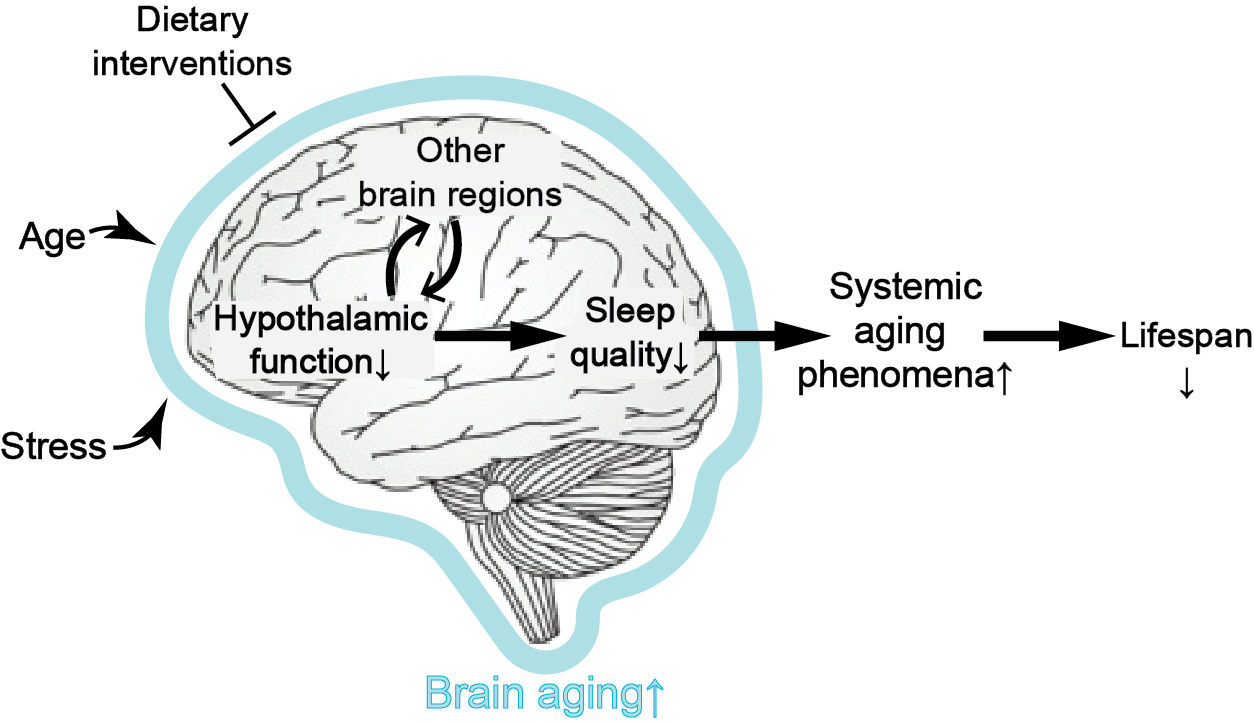
Figure. Mechanisms by which the brain controls systemic aging phenomena and longevity.
The function of the brain, particularly the hypothalamus, declines with age, leading to poor quality of sleep. Certain stress also causes a reduced quality of sleep. Additionally, hypothalamic dysfunction leads to abnormalities in functional brain networks that involve other brain regions. Such poor sleep quality leads to several systemic aging phenomena, and ultimately affects mammalian longevity. A nutritional intervention, such as dietary restriction, delays the aging process and extends lifespan presumably through the suppression of age-associated sleep alterations. Such age-associated sleep alteration may cause aging and affect mammalian longevity. Thus, age-associated sleep alterations can be one of determinant of mammalian longevity.
Selected Publications:
- Chu WM, Goto M, Kabetani K, Nishita Y, Zhang S, Shimokata H, Lee MC, Satoh A, Otsuka R*. Circulating miR-323–3p as a novel potential plasma biomarker for multimorbidity burden and cognitive decline in middle-aged and older adults: Results fromthe national institute for longevity sciences–longitudinal study of aging in Japan. Archives of Gerontology and Geriatrics Plus, 2024 1(4):100099,200, doi: 10.1016/j.aggp.2024.100099.
- Urushihata T, Goto M, Kabetani K, Kiyozuka M, Maruyama S, Tsuji S, Tada H, Satoh A. Evaluation of cellular activity in response to sleep deprivation by a comprehensive analysis of the whole mouse brain. Front Neurosci. 2023 17:1252689. doi: 10.3389/fnins.2023.1252689.
- Urushihata T, Satoh A. Role of the central nervous system in cell non-autonomous signaling mechanisms of aging and longevity in mammals. J Physiol Sci. 2024 74(1):40. doi: 10.1186/s12576-024-00934-3.
- Tsuji S, Brace CS, Yao R, Tanie Y, Tada H, Rensing N, Mizuno S, Almunia J, Kong Y, Nakamura K, Furukawa T, Ogiso N, Toyokuni S, Takahashi S, Wong M, Imai SI, Satoh A. Sleep-wake patterns are altered with age, Prdm13 signaling in the DMH, and diet restriction in mice. Life Sci Alliance. 2023 6(6):e202301992. doi: 10.26508/lsa.202301992.
- Satoh A. Central mechanisms linking age-associated physiological changes to health span through the hypothalamus. Aging Mechanisms II: Longevity, Metabolism, and Brain Aging. 2022 Springer Nature, p. 289-304. https://doi.org/10.1007/978-981-16-7977-3_18.